The comparison of adjectives


We often use adjectives and adverbs to compare.
There are three degrees of comparison, positive (or negative), comparative, and superlative.

💬 Examples


Positive degree (basic form)

masculine Sing.
starý muž ‒ an old man
feminine Sing.
stará žena ‒ an old woman
neuter Sing.
staré auto ‒ an old car

Plural
starí ľudia ‒ old people


Comparative degree

The comparative degree is formed by adding '-er' to the end of the adjective followed by 'than'.
This is the case of monosyllabic adjectives.
On the contrary, in the case of polysyllabic adjectives, the adjectives remain the same and use the word 'more' before the adjective.

This form is used when comparing two things or expressing a higher degree of the adjective.
To form the comparative degree, you usually add the suffix -ší to the adjective base.

💬 Examples:
m Sing.
starší muž ‒ an older man

f Sing.
staršia žena ‒ an older woman

n Sing.
staršie auto ‒ an older car

Pl.
starší ľudia ‒ older people


Superlative degree

This form is used to express the highest degree of an adjective.
To form the superlative degree, you typically add the prefix naj- to the adjective base and change the ending according to the gender and number of the noun.

💬 Examples:
m Sing.
najstarší muž ‒ the oldest man

f Sing.
najstaršia žena ‒ the oldest woman

n Sing.
najstaršie auto ‒ the oldest car

Pl.
najstarší ľudia ‒ the oldest people

Remember that these are the basic patterns for regular adjectives.
Irregular adjectives may have different forms in the comparative and superlative degrees.


Some commonly used but irregular adjectives

Irregular comparison is only used for the following adjectives (and their derived adverbs): dobrĂ˝, zlĂ˝, malĂ˝, veÄľkĂ˝, peknĂ˝.

dobrý (good) ‒ lepší ‒najlepší
zlý (bad) ‒ horší ‒ najhorší
veľký (big/large)‒ väčší ‒ najväčší
malý (small) ‒ menší ‒ najmenší
mladý (young) ‒ mladší ‒ najmladší
pekný (beautiful) ‒ krajší ‒ najkrajší


➠ Adverbs in Slovak


“Teaches you Slovak so much faster than with regular learning methods – in only 17 minutes per day!”

 
Fast and highly efficient learning method:
You can have your first conversation after 3 hours and become fluent after 50 hours – for PCs, smartphones and tablets!
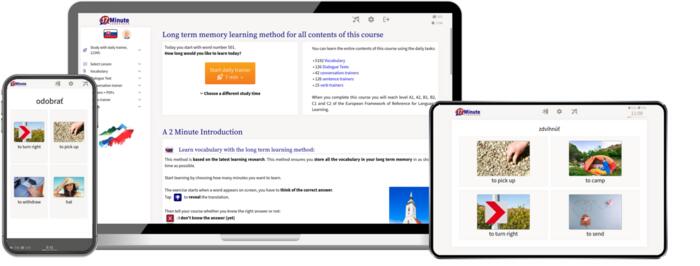
 
learn Slovak
 
Learn Slovak »

 
That's how the Slovak course differs from other language courses:
Recommended learning time: only a quick 17 minutes per day.
At any time – any place – on any device.
With the award-winning long-term memory learning method, you'll always remember Slovak.
With the novel superlearning technology, you'll learn 37.9% faster and become particularly receptive.
Learning Slovak has never been easier:
All exercises are automatically presented to you by the course every day.
As a result, you learn Slovak with a natural flow.
A vast variety of learning methods guarantees fun and success while learning and motivates you to continue learning Slovak every day.

Learn Slovak now »


Cover: How to learn any language in just 7 weeks
Free extra: “How to learn any language in just 7 weeks”

Learn all the tricks that will help you to learn any language quickly and efficiently—much faster than you could have ever imagined!

Read now for free »


More Slovak courses


Already beyond the basics? With the Slovak advanced course (B1/B2) you learn 1,800 new words and reach fluent level.
Intermediate Slovak »
 
Need Slovak for your job? The Slovak business course (B2–C2) teaches you over 2,000 business words for meetings, emails and negotiations.
Business Slovak »
 
Aiming for the highest levels? The Slovak proficiency vocabulary course (C1/C2) adds 2,100 specialist words to your Slovak.
Slovak proficiency vocabulary »


Free Slovak trial version

 
Test the Slovak course for free and get lots of study tips as well.