The verb system – beating heart of the Portuguese language!


Impersonal infinitive (infinitivo impessoal)

The impersonal infinite is used when there is no reference to a subject or when the infinitive verb is the subject itself.

Portuguese verbs end in -ar, -er and -ir in the infinitive form.
The three verb classes are named after these endings:
 
a-classe / e-classe / i-classe

💬 e.g.
brincar – to play (a-classe)
comer – to eat (e-classe)
rir – to laugh (i-classe)

⚠ There is one exception:
pôr – to put, to place, to lay
This verb has no typical ending and also has irregular forms.


Personal infinitive (infinitivo pessoal)

Formation of the infinitivo pessoal
1st pers. sg. only infinitive 1st pers. pl. infinitive + -mos
2nd pers. sg. infinitive + -it
3rd pers. sg. only infinitive 3rd pers. pl. infinitive + -em
 

The personal infinitive is used in sentences in which the subject in the main clause and in the subordinate clause is different.
It expresses the idea of an action and it could be considered as the base form of the verb.
There are two types, personal and impersonal infinitives.

💬 e.g.
🇵🇹 Se tu nĂŁo perceberes (subj.: 2nd person singular) isto, eu nĂŁo posso (subj.: 1st person singular) ajudar-te.
🇬🇧 If you don't understand that, I can't help you.
 
🇵🇹 Eles alugam um carro para irem atĂ© lá.
🇬🇧 They rent a car to drive there.
 
🇵🇹 Depois de pintarmos as paredes de todos os quartos, aspiramos o pĂł em todo o lado.
🇬🇧 After painting the walls of all the rooms, we vacuum the dust everywhere.

Furthermore, the infinitivo pessoal is used for impersonal expressions.

💬 e.g.
🇵🇹 É bom saberes a verdade.
🇬🇧 It's good if you know the truth.
 
🇵🇹 É lamentável nĂŁo ganharmos.
🇬🇧 It is a pity that we didn’t win.


Compound infinitive (infinitivo composto)

This verb form is mainly found in literary texts.
This verb form is only used with reference to the past tense.
Compound forms require the addition of one or more other verbs to make the meaning clear.

💡 Rule for forming the infinitivo composto:
ter + past participle of the verb

💬 e.g.
💬 e.g. ter falado – have spoken


➠ How to find the stem of a verb


“Teaches you Portuguese so much faster than with regular learning methods – in only 17 minutes per day!”

 
Fast and highly efficient learning method:
You can have your first conversation after 3 hours and become fluent after 50 hours – for PCs, smartphones and tablets!
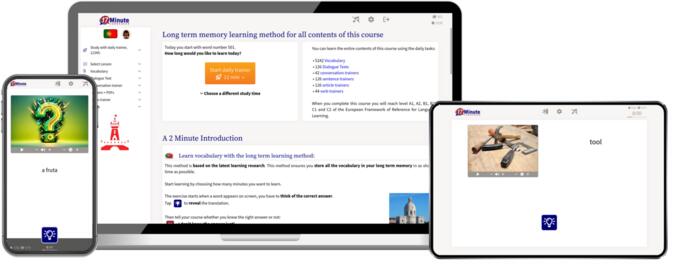
 
learn Portuguese
 
Learn Portuguese »

 
That's how the Portuguese course differs from other language courses:
Recommended learning time: only a quick 17 minutes per day.
At any time – any place – on any device.
With the award-winning long-term memory learning method, you'll always remember Portuguese.
With the novel superlearning technology, you'll learn 25.8% faster and become particularly receptive.
Learning Portuguese has never been easier:
All exercises are automatically presented to you by the course every day.
As a result, you learn Portuguese with a natural flow.
A vast variety of learning methods guarantees fun and success while learning and motivates you to continue learning Portuguese every day.

Learn Portuguese now »


Cover: How to learn any language in just 7 weeks
Free extra: “How to learn any language in just 7 weeks”

Learn all the tricks that will help you to learn any language quickly and efficiently—much faster than you could have ever imagined!

Read now for free »


More Portuguese courses


Already beyond the basics? With the Portuguese advanced course (B1/B2) you learn 1,800 new words and reach fluent level.
Intermediate Portuguese »
 
Need Portuguese for your job? The Portuguese business course (B2–C2) teaches you over 2,000 business words for meetings, emails and negotiations.
Business Portuguese »
 
Aiming for the highest levels? The Portuguese proficiency vocabulary course (C1/C2) adds 2,100 specialist words to your Portuguese.
Portuguese proficiency vocabulary »


Free Portuguese trial version

 
Test the Portuguese course for free and get lots of study tips as well.